Florida Keys · County and City Coordination

Building Permit Coordination in Monroe County, Florida

A Florida Keys project can involve more than a building application. We help organize the county or city filing route, allocation questions, site-review documents and permit follow-up. Whether you are preparing new work or resolving an existing file, send us the property location, proposed scope and current status. We will help identify the administrative steps that need attention.

Independent permit coordination for homeowners, contractors and property teams across Florida. Assistance in English and Spanish.

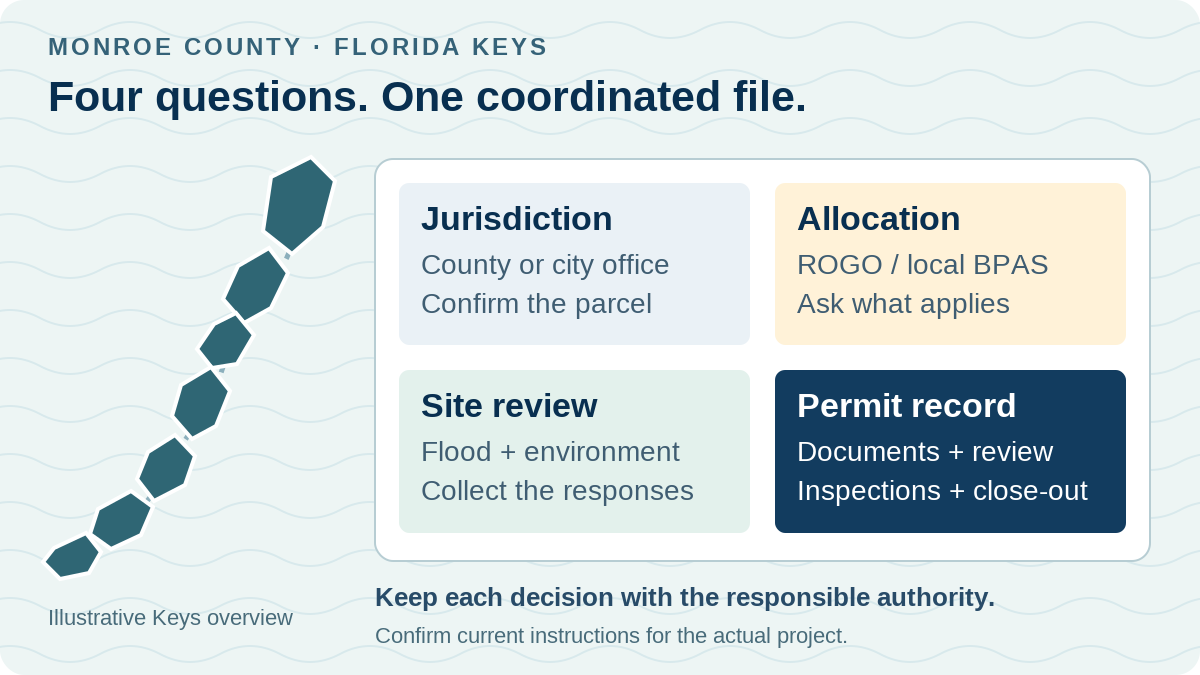
Illustrated Florida Keys project overview with four coordination questions: jurisdiction, allocation, site review and permit record

Start With the Location

Which Office Should Review Your Site?

Confirm the Unincorporated County Route

Monroe County Current Planning administers land-use planning for unincorporated Monroe County. Identify the parcel and its jurisdiction before choosing an application or relying on a nearby project’s paperwork.

We help organize that inquiry using the site address, real-estate or parcel number, proposed use and available records. A mailing address, island name or mile marker can help locate the property, but the responsible office should confirm the actual review route. Keep its response with the project file so the contractor and design team are working from the same information.

Use the Municipality’s Own Instructions

The county’s municipal directory identifies Key West, Islamorada, Marathon, Key Colony Beach and Layton. A project inside a municipality needs its local process checked rather than assuming the county portal is the filing destination.

Tell us which city has already responded and share any existing record number. We help connect planning, building and other administrative questions with the appropriate office. City forms, allocation procedures and submission systems should be checked separately; a county instruction should not automatically be applied to a municipal project.

County Applications and Revisions

Prepare the File for Online Review

Follow the Current OPAL Instructions

The county’s Online Permitting Services page identifies Oracle Permitting and Licensing, or OPAL, as its online system. It requires user registration for people submitting applications and provides instructions for contractor-agent authorization and affiliated project participants.

We help organize the submission and clarify who should receive correspondence. Use the county’s current registration and authorization instructions with your team. Keep account access under the appropriate person’s control; share the application status and requested documents with us rather than sending passwords or verification codes.

Distinguish an Application From an Issued Permit

The county forms directory separates changes of contractor, agent authorization, extension requests and revisions. Its Permit Revision Submittal Form (PDF) specifically addresses revisions after permit issuance.

For an existing file, explain whether it is under initial review or already issued, and include the latest comments. We help track the correct administrative response and the documents supplied by your professionals. Staff should confirm the accepted route for the requested change. A technical revision, contractor change and request to finish a permit are different tasks.

Residential Growth and Intended Use

Keep Allocation Questions Separate From Filing

Does a New Home Need an Allocation?

The county’s ROGO/NROGO page describes residential and nonresidential allocation systems. At our October 30, 2026 review, it reports that the prior market-rate residential allocation pool has closed and amendments are underway for a new period. It says new building applications can continue to be reviewed while ROGO submissions await that next period.

Ask Planning how the current notice affects the particular proposal and any earlier allocation or exemption record. We help collect those written responses alongside the application. An application under review is not confirmation that an allocation is available. We do not promise an award, score, exemption or opening date.

Do the Cities Use the Same System?

Key West BPAS has its own residential-development process and current application-cycle materials. Islamorada BPAS describes its separate competitive system and housing and nonresidential categories. Confirm the municipality’s current instructions for the proposed work.

We help organize the property record, prior awards and questions for staff. Ask whether the project needs a new allocation, involves an existing one or requires another determination. Keep that response distinct from plan-review comments and permit issuance. County ROGO information does not establish eligibility or availability within a city.

Two Municipal Filing Examples

Use the Checklist for the Actual Project

Key West: Completeness and Historic Review

The Key West permit requirements page provides checklists by work type and identifies a Certificate of Appropriateness for exterior work in the Historic District. The linked city application-process document (PDF) explains completeness review and responses to plan-review comments.

Share the scope, existing plans and any historic-review correspondence. We help assemble the administrative package and track missing items with the project team. Obtain current project-specific instructions before submission; a checklist for interior work or a different property may not cover the proposed exterior changes.

Islamorada: CityView and Scope-Based Documents

Islamorada Building Services directs permit applications through CityView. Its permit submittal matrix (PDF) shows that supporting documents vary by permit type and site conditions, including vegetation, shoreline and right-of-way questions. The matrix is general guidance, and staff may request more information.

We help compare the proposed scope with the requested attachments and identify who will supply each item. Your surveyor, designer, engineer and contractor provide their professional work. Confirm which supporting authorizations are needed and when they must be supplied; the matrix is not a determination that the site or project is approved.

Floodplain and Environmental Coordination

Bring Site Conditions Into the File

Confirm the Relevant Flood Information

The county’s Floodplain Management and Awareness page links flood maps, building requirements and elevation-certificate resources. It also distinguishes preliminary coastal-map information from other flood resources and lists municipal contacts.

For proposed repairs, additions or new work, provide available surveys, elevation documents and prior floodplain responses. We help organize the inquiry and requested records. Ask the responsible office which information governs the actual project and whether further review is required. Qualified professionals and the authority evaluate technical requirements; a map image or a neighboring building is not a property-specific determination.

Identify Environmental Questions Early

County Environmental Resources publishes information on species referrals, wetland evaluation, stormwater and the Big Pine Key and No Name Key habitat programs. Those topics can require their own documentation and agency responses.

Tell us about planned clearing, vegetation changes, shoreline work and existing environmental correspondence. We help keep requested reports and administrative steps connected to the permit package. The responsible agencies and qualified professionals determine applicable reviews. Our role is coordination; we do not evaluate habitat, prepare engineering or determine that an outside authorization is unnecessary.

Residential and Commercial Projects

Give the Team a Clear Description of the Work

For a Home or Property Improvement

For residential permit coordination, explain whether the proposal is a new home, addition, repair, renovation or replacement. Include the existing permit history and any written allocation or site-review response you already have.

We help assemble a document list and track questions among the owner, contractor, design team and reviewing office. Identify the work that is actually proposed rather than starting with a generic permit label. Changes to the footprint, exterior, use or site may need different supporting information from a project that stays within the existing scope.

For a Business or Existing Commercial Space

The county Building Department describes reviews involving planning, environmental, building, floodplain and fire disciplines. For commercial permit coordination, identify the proposed business use, existing occupancy and planned alterations.

We help organize the agency questions and follow the review record. An earlier tenant’s use or a prior permit may provide background without resolving the current proposal. Share existing approvals and ask what must be confirmed for the new scope. Planning, allocation, fire and building questions should remain visible as separate items until staff provides the relevant response.

Permit History and Completion

Find the Record and Follow It Through

Recover the Relevant Application History

The county publishes a public-records request route and provides public permit-search information through its permitting resources. Older and newer records may be handled through different systems; ask staff where the specific file is maintained.

For permit research coordination, provide the address, parcel reference, known permit number and the question you need answered. We help organize the inquiry and materials returned. A city file may need a separate request. Keep the response and supporting documents together rather than treating an incomplete search as the final status of the work.

Track Inspections and the Closing Status

The county’s inspection instructions distinguish procedures by the permit application date and describe how to verify completion. Confirm the current request method for the particular record, including any outstanding documents, before arranging the next inspection.

With permit follow-up assistance, we help track comments, requests and completion questions. Your contractor handles readiness and the work itself. Retain inspection results and the final written status. Our pre-construction coordination can also help organize unresolved records before another project begins.

A Practical Starting Point

Tell Us What Your Monroe County Project Needs

For Proposed Work

  • Site address, parcel reference and known jurisdiction
  • Proposed construction or intended business use
  • Available plans, survey and existing approvals
  • Allocation, historic, floodplain or environmental questions

For an Existing Permit File

  • Responsible office and application or permit number
  • Current review status and latest comments
  • Contractor and design-professional contacts
  • Pending revisions, inspections and completion documents

This is our consultation intake list, not an official permit checklist. Use our contact form for a short project summary. Keep passwords, verification codes and sensitive personal or financial information out of the initial message.

Explore our permit services, the Florida building permit process and información en español.

Official resources reviewed October 30, 2026

Allocation notices, filing systems and project requirements can change. Use the linked official resources and confirm the current route with the responsible office before acting.

Get Help With Your Monroe County Permit

Share the property location, proposed work and current status. We will help organize the paperwork and the next coordination step.

Building Permits Florida is an independent company. The responsible authority determines permit requirements, approvals, inspections and agency timing.